Overview
About this plan
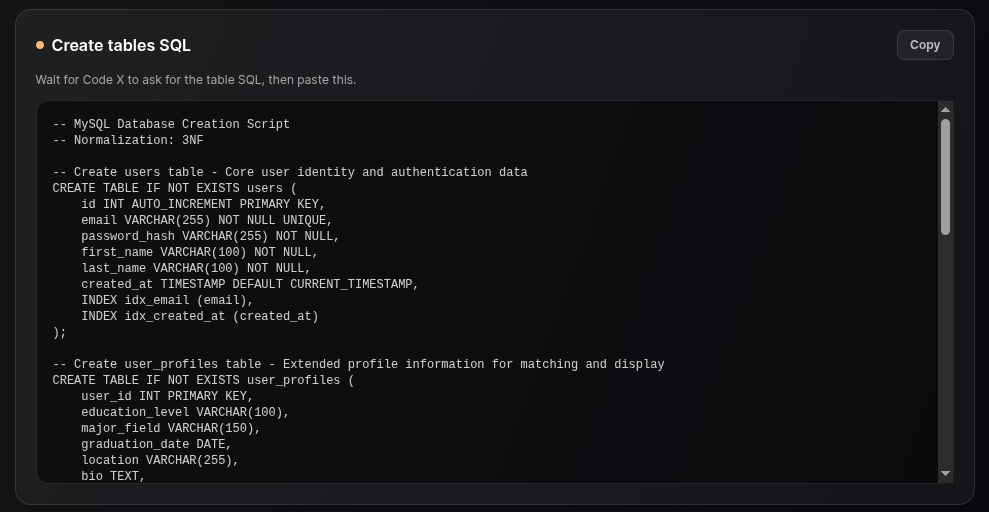
What's inside: A 3NF-compliant MySQL schema, ready-to-run SQL scripts, and a 'Handshake' CRUD query library.
We generate production-grade SQL, link your tables with professional keys, and provide sample data plus query templates so your data engine is ready to ship.
Outcome
The Goal
Move Beyond "Lists of Fields": You have a data model; now you need a machine. This stage translates your architecture into optimized SQL scripts that build your tables and enforce relationships correctly.
Enforce Data Integrity: Stop orphaned records and duplicate data before they start. We implement primary and foreign keys that ensure your users, posts, and data stay linked perfectly as your app grows.
Prepare for Backend Integration: We don’t just give you tables; we give you the "Handshake." You get query templates for every core action (Create, Read, Update, Delete) so your backend knows exactly how to talk to your data.
Audience
Who This Is For
Applications
Best Use Cases
Students Mastering Relational Fundamentals
Learn when to use a "Join Table" for many-to-many relationships and how to use Foreign Keys to prevent orphaned data. These are the skills recruiters look for in backend roles.
Founders Building MVPs with Growth in Mind
Ensure that when you add "Feature 2" next month, you don't have to migrate your entire database. Professional schema design allows you to add features without breaking existing data.
Teams Aligning on Data Naming Conventions
Prevent integration errors by ensuring the whole team uses the same table names and field types. No more "user_id" vs "userId" bugs.
Methodology
Why This Approach
Next Steps
What's next?
Quick Info
We generate MySQL syntax for the local XAMPP setup. The relational logic is universal and can be ported to Postgres or SQLite with minimal changes.
Process
How it works
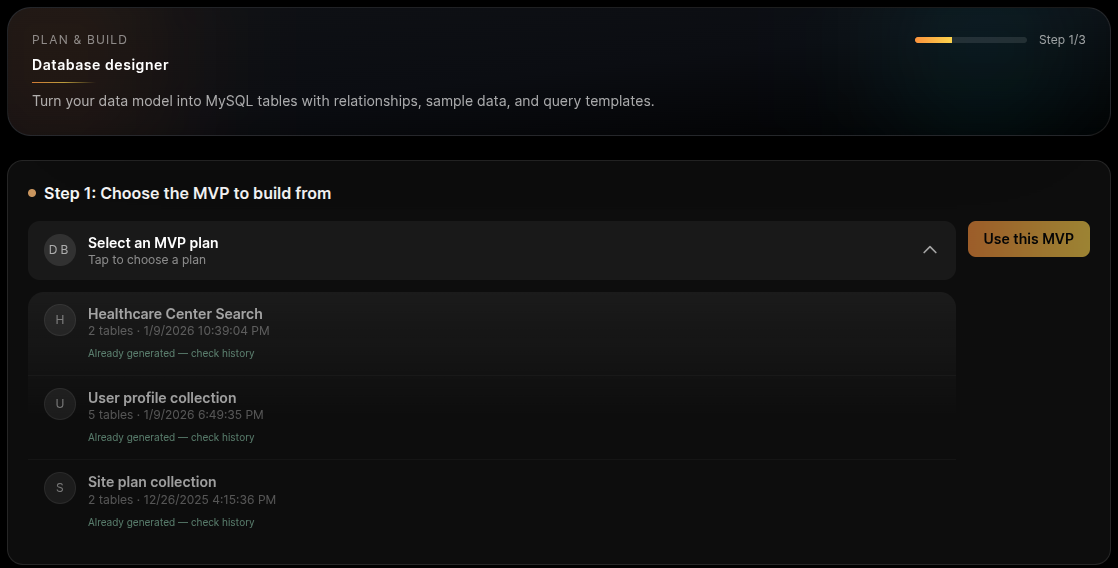
Step 1: Schema Translation. We convert your System Architecture into production-grade SQL. This includes choosing the right field types (INT, VARCHAR, TIMESTAMP) to optimize performance and storage.
Step 2: Relational Linking. We build the "web" of your app. One-to-many and many-to-many relationships are established via foreign keys and join tables, ensuring your data remains consistent and normalized.
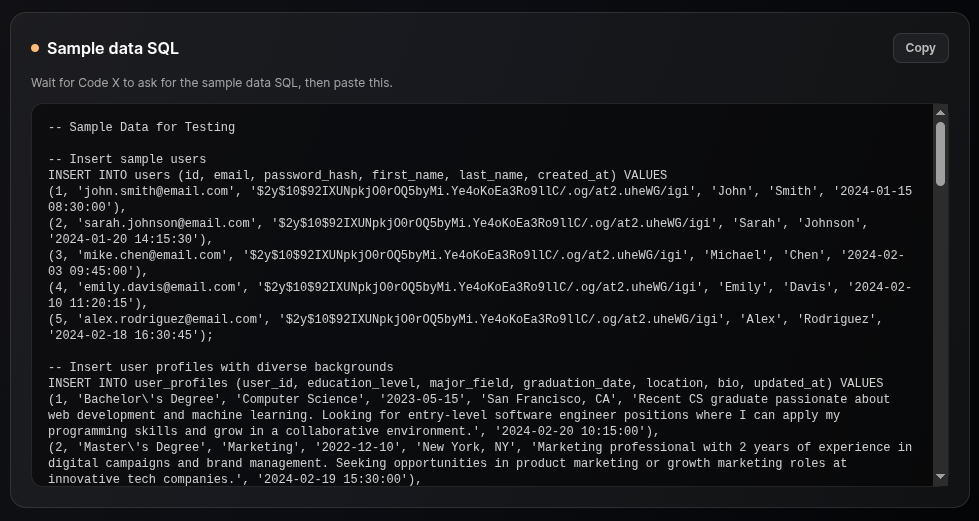
Step 3: The Engine Check. You receive sample data and query templates to verify your database is "Save-and-Fetch" ready. Test your setup before writing a single line of backend code.
 MySQL
MySQLDeliverables
What you'll get
You walk away with a complete, functioning database engine. This is a professional relational system with proper field types and foreign key constraints that prevent data corruption. You aren’t just getting empty tables; you are getting a populated environment with sample records and a library of the exact SQL queries your backend will use to fetch, create, and update data. You will see the backend-to-database "handshake" clearly mapped out before you ever start writing Flask logic.
Prerequisites
Before you begin
Cost
1 credit per screen
Time
15–30 minutes
Requirement
A verified System Architecture and MySQL running via XAMPP.