Overview
About this plan
What's inside: Production-ready Flask routes, synchronized SQL queries, and 'Fail-Safe' error handling.
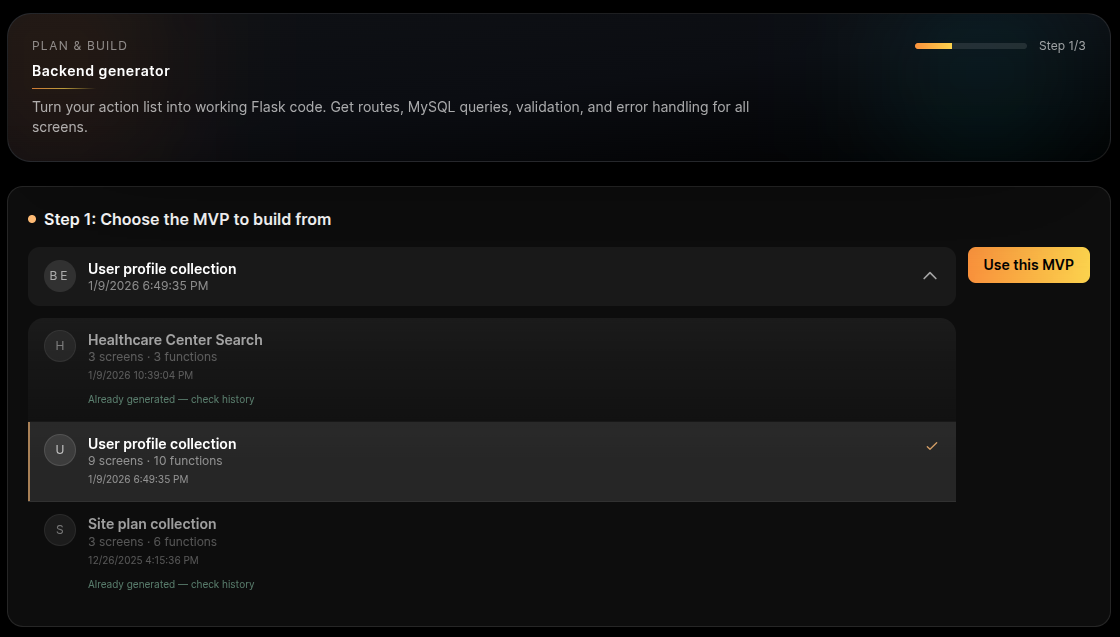
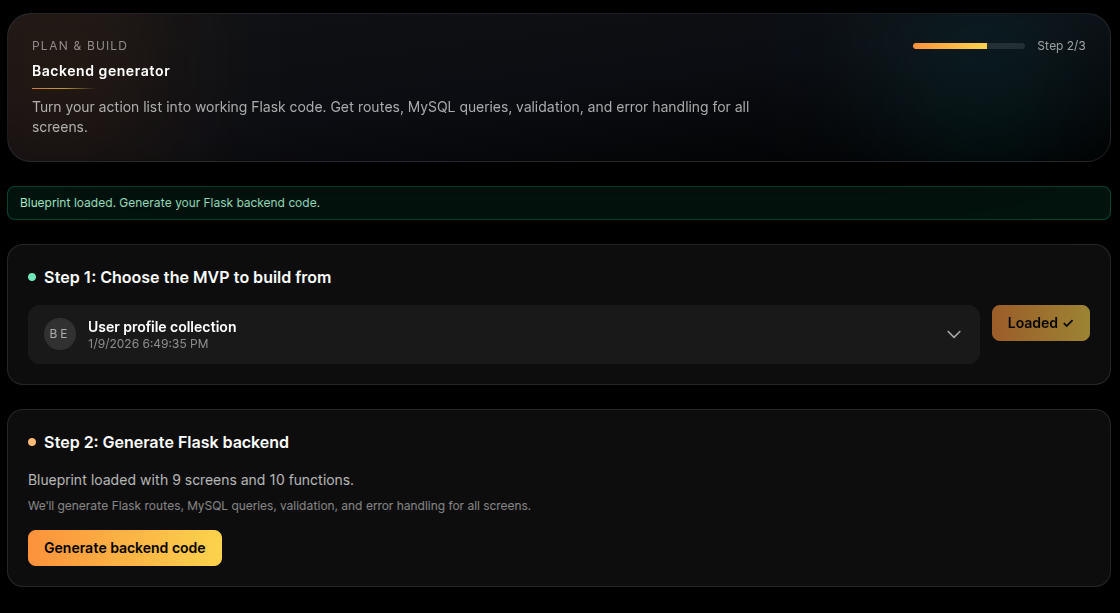
Translate action requirements into secure Flask routes, sync MySQL queries to your schema, and add validation so data flows safely.
Outcome
The Goal
Master the Request-Response Cycle: Your database is ready; now you need the brain. This stage generates the Flask routes that listen for user actions and return the data your frontend needs to display.
Eliminate Integration Guesswork: Stop fighting with "Table Not Found" errors. We generate Python logic that uses your exact table names and field types from the previous stages.
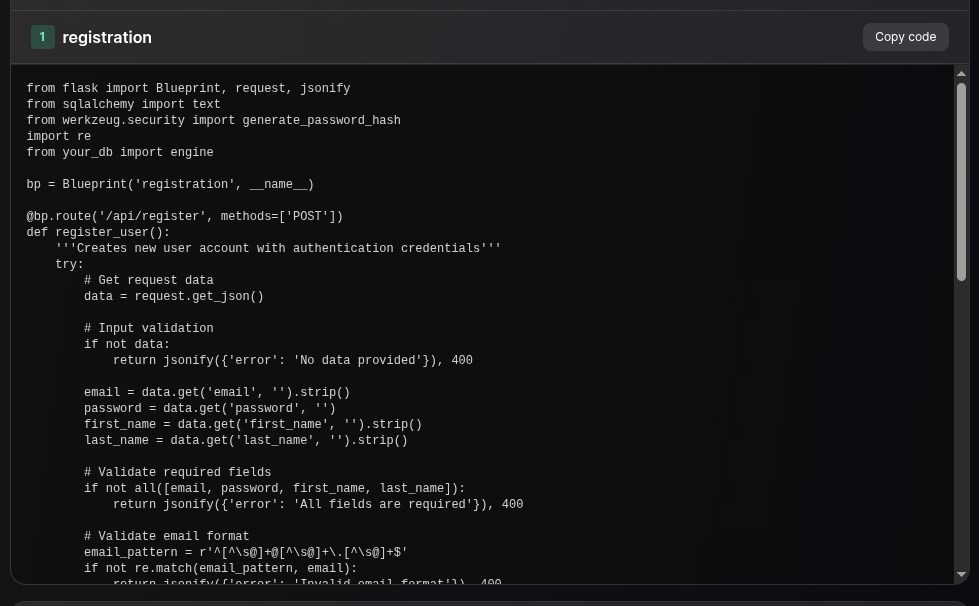
Ship Secure, "Unbreakable" Code: We implement professional validation and try-except blocks. Your backend will catch bad data and handle database failures gracefully instead of crashing your entire app.
Audience
Who This Is For
Applications
Best Use Cases
Students Bridging the "Frontend-Backend" Gap
Tutorials often leave out the connection. This shows exactly how a form submission on a web page becomes a row in a database table.
Founders Building Stable, Launch-Ready APIs
Don't launch a "brittle" app. Use professional error handling to ensure that even when things go wrong (like a database timeout), your users get a clean message instead of a broken page.
Learning Complex Joins and Multi-Table Logic
If your feature needs to fetch data from three different tables at once, we provide the specific JOIN queries and Python logic to handle that complexity.
Methodology
Why This Approach
Next Steps
What's next?
Quick Info
We use Flask + MySQL logic. The structure and security patterns are easily transferable to any other backend language.
Process
How it works
Step 1: Action-to-Route Mapping. We translate your user requirements (e.g., "submit a post") into specific Flask endpoints. You get the clean, PEP 8 compliant Python code for every action.
Step 2: SQL Synchronization. We write the exact MySQL queries (SELECT, INSERT, etc.) that correspond to your schema. We use parameterized queries by default to protect you from SQL injection.
Step 3: Validation & Error Shielding. We add logic to sanitize user input and catch common errors (like missing fields or connection timeouts) before they reach your data engine.
 Flask
Flask Python
 MySQL
MySQLDeliverables
What you'll get
You walk away with the "functional bridge" of your application. This is working Flask code that handles the entire data lifecycle: it accepts a request from the user, validates that the data is safe, runs the correct SQL query against your live database, and returns a clean response. Because these routes are generated from your actual schema, they work out of the box. You aren't just writing code; you are building a secure, professional API.
Prerequisites
Before you begin
Cost
2 credits
Time
20–40 minutes to integrate and test your first route
Requirement
An initialized MySQL database and an approved Action List from Architecture.